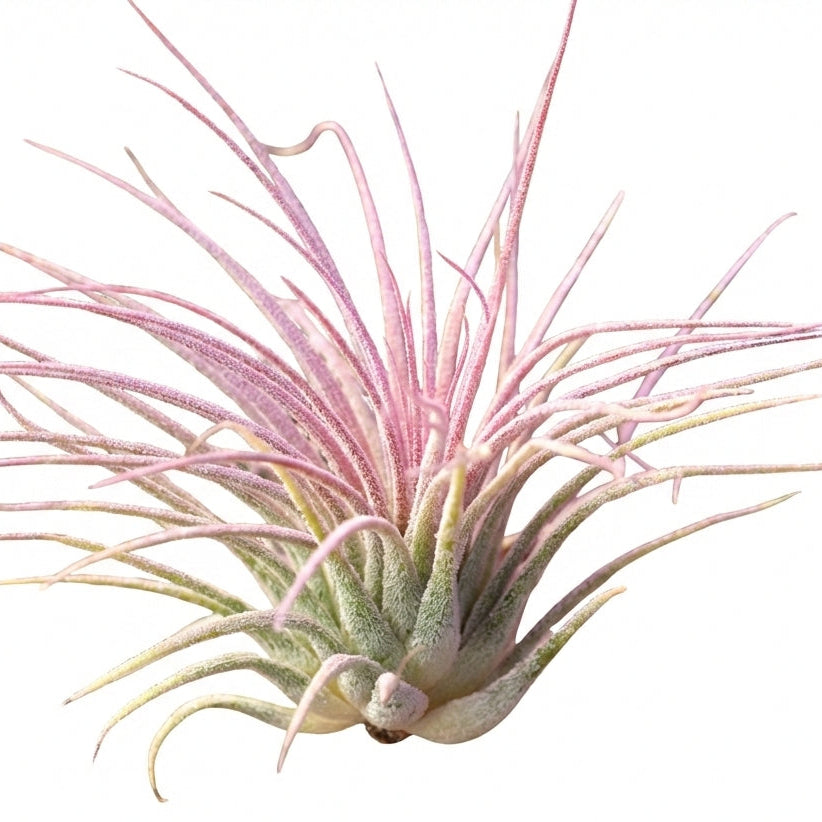

Tillandsia ionantha Lilac
Couldn't load pickup availability
-
![]() Tillandsia ionantha Lilac is a compact air plant from the bromeliad family, native to the cloud forests and woodlands of Mexico and Central America. This small epiphyte absorbs water and nutrients through its leaves rather than roots, growing naturally on trees and rock faces without soil.
 Lilac forms a tight rosette of narrow, curved leaves that emerge forest green and gradually shift to soft lilac-purple as the plant matures, especially under bright light. The foliage is smooth and thin, and the entire plant stays small and compact, rarely exceeding 2 to 3 inches in height. It produces fine white trichomes (tiny leaf hairs) that help it absorb moisture from the air.
 The plant blooms with small red or purple tubular flowers that appear from the center of the rosette, typically in spring or early summer. Lilac produces pollen and may trigger mild allergies in sensitive individuals. Beyond flowers, it naturally humidifies the air around it and releases oxygen at night.
 Lilac grows well under office LED lights and handles drafty spots without stress, though it is sensitive to direct air from AC units and heaters. Move it outside in summer and it handles balcony wind and rain without damage. This plant is pet-friendly and safe around cats and dogs. You can leave it up to ten days without water. The plant works equally well displayed on a shelf, in a terrarium, or mounted on driftwood or cork bark. You can rotate it every few weeks for even growth, or leave it stationary in your preferred spot.
-
 Tillandsia ionantha Lilac grows well in bright indirect light and does well under office LED lights without natural sunlight.
 Soak it in room-temperature water for 20-30 minutes once weekly, shake off excess water to prevent rot, and mist the leaves every few days to maintain high humidity.
 Lilac needs no soil and grows without it; mount it on driftwood, cork bark, wire frames, or display it in an open dish with no glue touching the base.
 It prefers temperatures between 50°F and 85°F and tolerates dry, heated air from AC and heating units.
![]() Lilac is a slow-grower that needs specialized bromeliad or air plant fertilizer diluted to quarter strength, applied during weekly soaks in the growing season.
 It is hardy in USDA zones 10 and 11, surviving outdoors year-round where winter temperatures rarely drop below 40°F. It grows outdoors in southern Florida, coastal California, southern Texas, Hawaii, and the warmest regions of Arizona, Georgia, and South Carolina.
Perfect For Every Occasion: wedding favor, baby shower favor, corporate gathering, housewarming gift, thank-you gift, office party favor, employee appreciation
What This Plant Symbolizes: resilience and connection to spirit, transformation and personal growth, vitality and renewal, air purifying wellness
A Thoughtful Gift For: plant lovers seeking hard-to-kill houseplants, minimalist décor enthusiasts, a coworker or boss, someone who lives in a small space, air plant collectors, those with busy lifestyles, gift-givers seeking pet-safe options
-
Q: What light does Tillandsia ionantha Lilac need indoors?
A: Bright indirect light works well, and it also grows under office LED lights and tolerates medium-light corners without leaf damage.
Q: How often should I water it?
A: Tillandsia ionantha Lilac needs high humidity; soak it for 20-30 minutes once a week and mist every few days to prevent drying in heated spaces.
Q: Is Lilac safe for cats and dogs?
A: Yes, this plant is pet-friendly and non-toxic if chewed or ingested.
Q: Can it survive travel?
A: Lilac can be left without water for up to ten days; soak it when you return home.
Q: Why are Lilac leaves turning brown?
A: Brown leaf tips usually occur when the plant is too dry or exposed to direct AC or heater air; increase misting frequency and move it away from vents.
Q: How do I propagate it?
A: Lilac produces offsets or pups around the base after flowering; once the pup grows to about 1 inch, gently separate it and mount it as you would the parent plant.