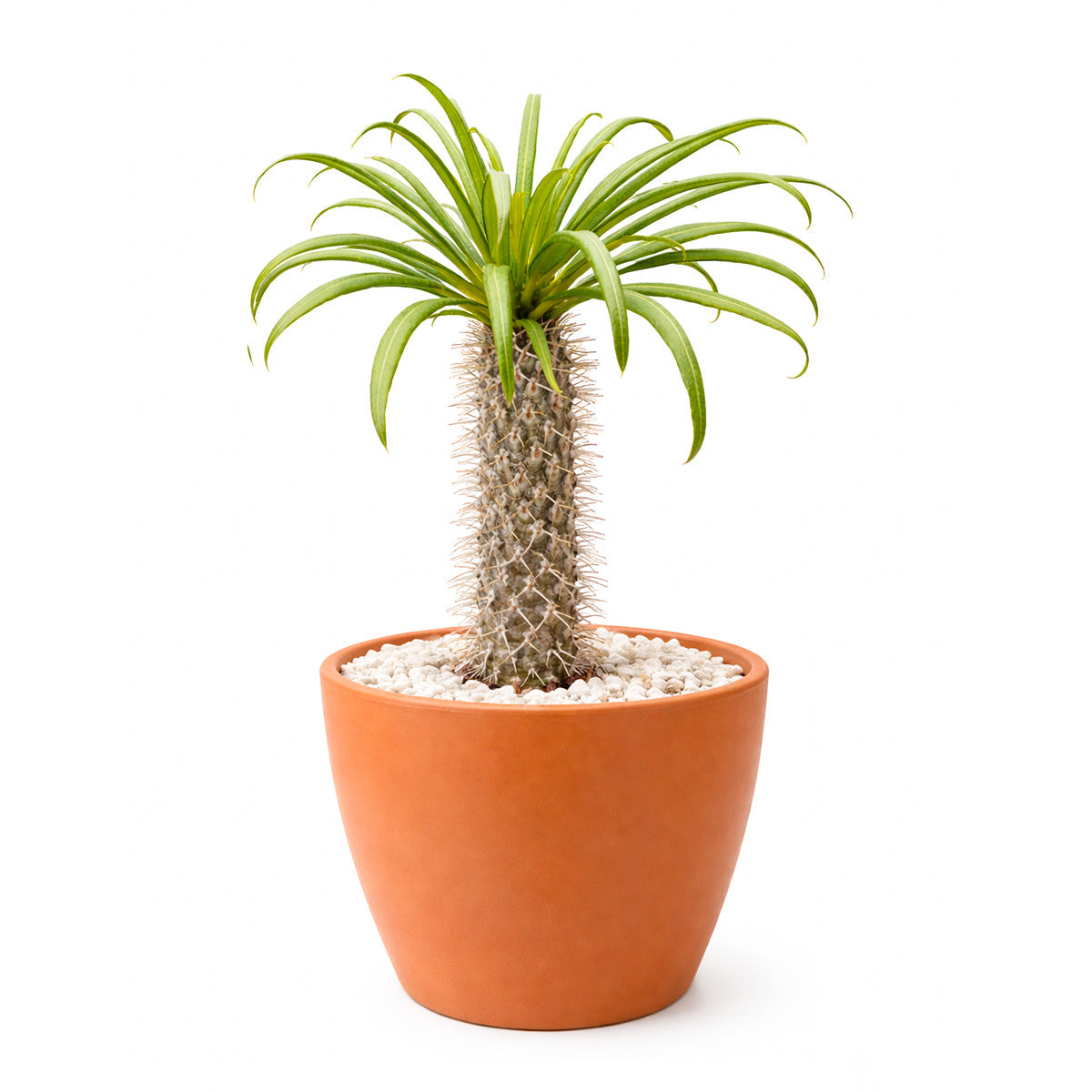


Pachypodium 'lamerei' (Madagascar Palm)
Couldn't load pickup availability
-
![]() Pachypodium 'lamerei' (Madagascar Palm) is a rare architectural succulent native to the arid, sun-baked regions of southern Madagascar, where it survives in rocky, dry terrain with minimal rainfall. Despite its common name, it belongs to the Apocynaceae family and is not a true palm at all. This bold statement plant has become popular among collectors who appreciate dramatic, low-maintenance desert succulents with genuine structural presence.
 It features a thick, silvery-gray trunk densely armored with sharp spines arranged in clusters along prominent ridges, creating an unmistakably sculptural form. A crown of long, narrow, glossy green leaves emerges from the very top, contrasting sharply against the spiny base. Madagascar Palm grows as a single upright column and can reach impressive heights indoors over time.
 Given the right conditions, it produces clusters of white, star-shaped flowers at the top of its trunk during the summer months on mature plants. A crucial trigger for blooming is a nighttime temperature drop, which signals the plant to set flower buds. Indoor specimens kept warm year-round rarely flower, so that cool evening dip is essential for flowering.
 Rotate Madagascar Palm regularly to keep the form symmetrical and even as it grows toward its light source. Move it outdoors for summer sun, but shelter it from heavy rain to protect the roots from saturation. Keep this succulent well out of reach of pets and small children, as the sap can cause skin and paw irritation and it should never be nibbled or ingested. You can leave it up to ten days without water. It tolerates dry heated indoor air and requires a heavy, stable pot to prevent toppling as it grows taller.
-
 Pachypodium 'lamerei' (Madagascar Palm) grows well in direct sun or the brightest spot available, needing at least six hours of strong light daily.
 Water it deeply every two to three weeks in summer, reducing to once monthly or less in winter when the plant is resting.
 Madagascar Palm does best in a fast-draining cactus or succulent mix blended with extra perlite or coarse sand.
 It prefers temperatures between 60 and 95°F and should never be exposed to frost or freezing conditions.
![]() Madagascar Palm is a slow grower, typically adding just a few inches per year, and a light balanced fertilizer applied once or twice in spring and summer is plenty.
 It is hardy in USDA zones 9-11, where temperatures stay well above freezing. It grows outdoors in Florida, coastal and southern California, Hawaii, southern Texas, Arizona, Louisiana, Mississippi, Alabama, Georgia, and South Carolina during the warmer months. Portions of Nevada, New Mexico, and the Oregon coast within zone 9 may support it seasonally, though containerizing and bringing it indoors before any cold snap is always the safest approach.
Perfect For Every Occasion: housewarming, graduation gift, corporate or client gift, birthday party favor, Father's Day, retirement, event giveaway, just because
What This Plant Symbolizes: resilience, endurance, protection, growth
A Thoughtful Gift For: dad or father-in-law, a plant-loving friend, a coworker or boss, green-thumbed grandparents, a new homeowner
-
Q: How often should I water Pachypodium 'lamerei' (Madagascar Palm)?
A: Water deeply every two to three weeks during the growing season. Let the soil dry completely between waterings to prevent root rot from prolonged moisture.
Q: Is the sap toxic to pets?
A: Pachypodium 'lamerei' (Madagascar Palm) sap can cause skin and paw irritation on contact, and ingestion can be harmful. Keep it on a high shelf well out of reach of cats and dogs.
Q: How much light does Madagascar Palm need?
A: It loves direct sunlight for several hours daily and performs best in a south- or west-facing window. Intense afternoon summer sun can scorch the foliage in confined spaces.
Q: How quickly does it grow?
A: Madagascar Palm is a slow grower, typically adding just a few inches per year under good light and proper care. Its impressive sculptural trunk develops over time.
Q: Can I move Madagascar Palm outside in summer?
A: Yes, moving it outdoors for summer boosts growth and encourages blooming on mature plants. Always keep it sheltered from direct rain and bring it back inside before nighttime temperatures drop in autumn.
Q: Is it a rare plant?
A: Madagascar Palm is considered a rare collector succulent not commonly found in typical garden centers. Its dramatic architectural form and slow-grown trunk make it especially desirable among plant enthusiasts.