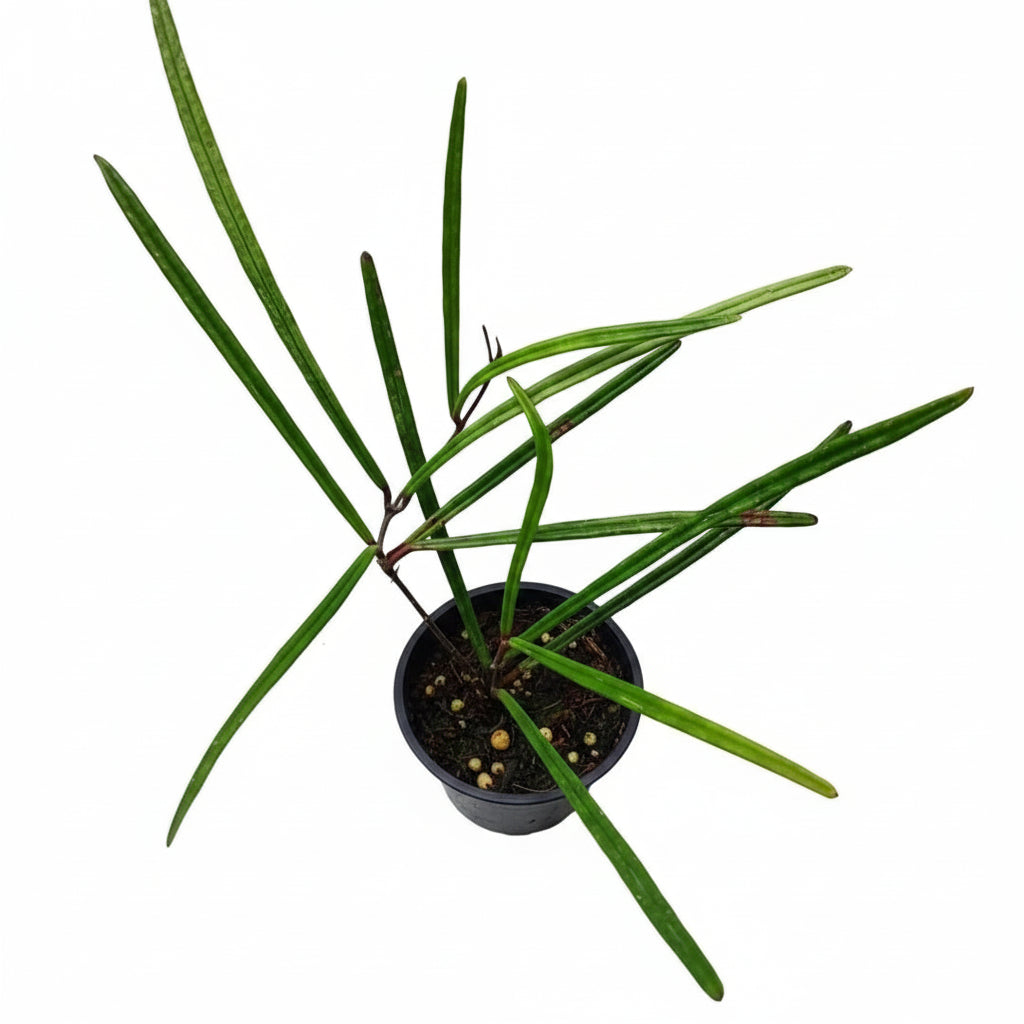


Hoya Insularis
Couldn't load pickup availability
-
![]() Hoya Insularis is a rare epiphytic wax plant native to the tropical islands of Southeast Asia, where it grows as a climbing vine on forest trees. Part of the Apocynaceae family, it has become increasingly sought after by hoya collectors for its uncommon availability and trailing form.
 The plant produces thick, waxy leaves with a green finish and a slightly succulent texture that stores moisture. Vines trail and cascade with a rhythmic pattern as the plant matures, making it a natural fit for hanging baskets where each stem can develop its full spreading character.
 It produces clusters of small, star-shaped flowers with a sweet fragrance. A drop in nighttime temperature during the growing season tends to trigger blooming, so moving it to a slightly cooler room in the evening can encourage bud formation and flowering.
 Position it near a kitchen or bathroom window where ambient moisture keeps it content and trailing vines can develop without constraint. It stays pet-safe around cats and dogs, handles up to ten days without water. Keep it away from air conditioning vents and heater drafts, shelter it from rain, and rotate the pot regularly so all sides receive balanced light and even growth.
-
 Hoya Insularis grows well in bright indirect light and performs well under quality office LED grow lights when natural light is unavailable.
 Water it every 10 to 14 days during summer, allowing the soil to dry between waterings, then reduce to once every 3 weeks in winter.
 Hoya Insularis performs best in a chunky, fast-draining mix of orchid bark, perlite, and a small amount of potting soil to mimic its epiphytic roots.
 It prefers temperatures between 60 and 85°F and has no frost tolerance below 50°F.
![]() Hoya Insularis is a moderate grower that benefits from a balanced liquid fertilizer diluted to half strength and applied monthly during spring and summer.
 It is hardy in USDA zones 10 to 12, where temperatures rarely dip below 30 to 35°F. It grows outdoors year-round in southern Florida, Hawaii, and the warmest pockets of Southern California and South Texas. In Arizona, Nevada, coastal Louisiana, Mississippi, Alabama, Georgia, and South Carolina, it can grow outdoors during warmer months but must be moved indoors before cold snaps arrive.
Perfect For Every Occasion: housewarming gift, corporate or client gift, rare plant collector gift, plant lover's birthday, new plant parent present, collector's exchange event
What This Plant Symbolizes: subtle elegance, patience and transformation, endurance and resilience, exotic beauty, refinement
A Thoughtful Gift For: a devoted plant collector, the rare plant enthusiast, a friend with a modern minimalist style, coworkers or clients who appreciate unique specimens, anyone who values patience and slow living, a pet-owning plant parent
-
Q: How often should I water Hoya Insularis?
A: Every 10 to 14 days during the growing season; the soil should dry out between waterings. Cut back to once every 3 weeks in winter.
Q: Can it survive a trip without water?
A: Hoya Insularis can last up to ten days without water before showing signs of stress.
Q: Is Hoya Insularis pet-friendly?
A: Yes, it is non-toxic and safe around cats and dogs.
Q: How do I encourage blooms?
A: Hoya Insularis responds to a slight drop in nighttime temperature during the growing season, which can trigger bud formation. Keep it in bright indirect light and avoid moving it once buds appear.
Q: Can Hoya Insularis be propagated from cuttings?
A: Yes, it propagates well from stem cuttings in water or moist, well-draining medium during the warm growing season. Each cutting should have at least one node for the best success rate.
Q: What humidity does it need?
A: It does best with humidity levels between 50 and 70 percent. A kitchen or bathroom window provides the moisture it prefers; avoid placing it near air conditioning vents or heaters.