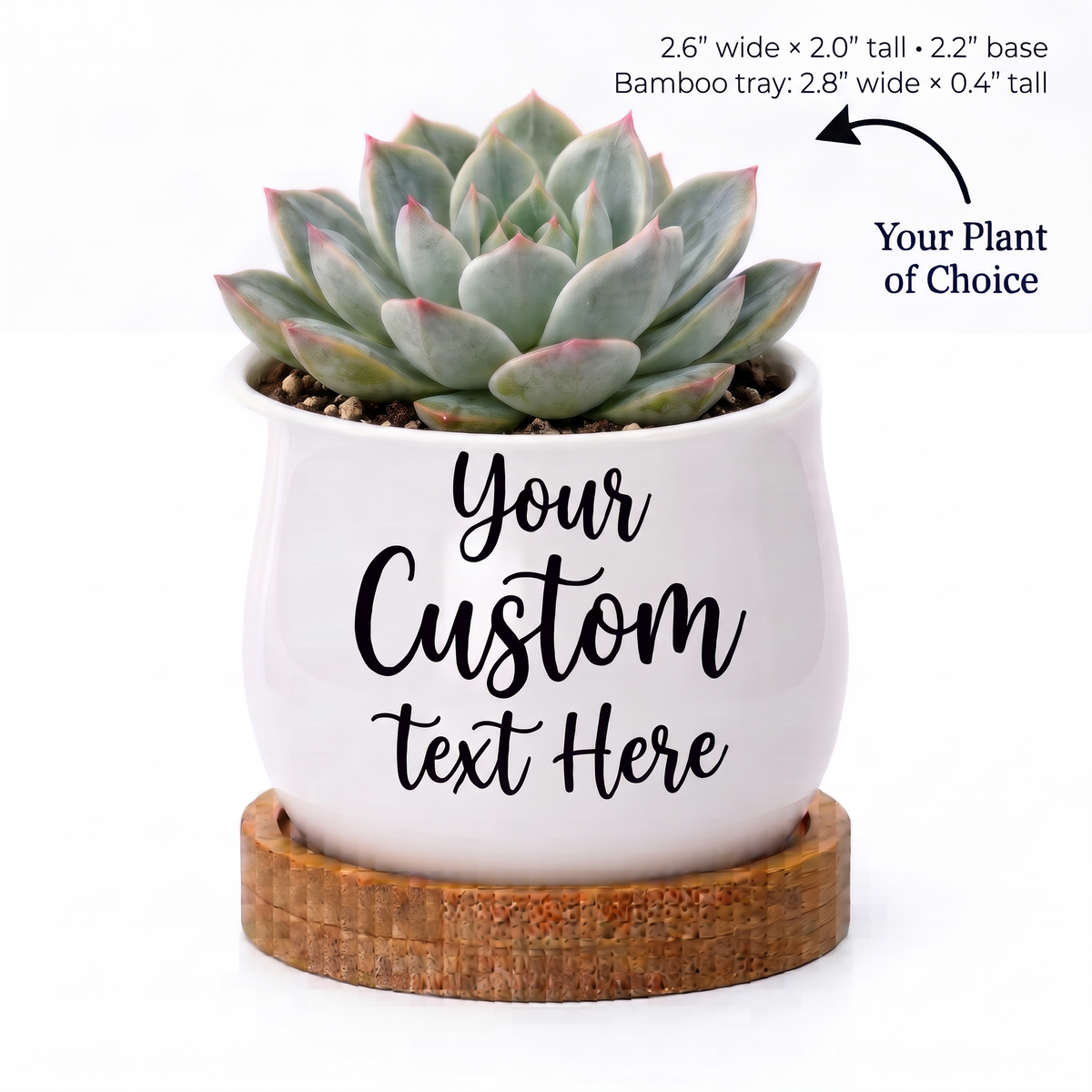


Echeveria ‘Allegra’
Couldn't load pickup availability
-
![]() Echeveria 'Allegra' is a succulent hybrid in the Crassulaceae family that traces its roots to the semi-arid highlands of Mexico. It combines drought tolerance with a compact rosette form.
 'Allegra' forms a symmetrical blue-green rosette with wide, paddle-shaped leaves that taper to soft points. A powdery farina coating gives the foliage a frosted finish, and the leaf tips often flush with subtle silvery or lavender tones. As a clustering grower, it gradually produces offsets around the base, so a single plant slowly expands into a layered display of multiple rosettes.
 Patient growers can expect slender arching bloom stalks carrying small, lantern-shaped flowers in coral or pinkish-orange tones. A temperature drop during late winter or early spring tends to trigger blooming, so moving it to a slightly cooler spot in the evenings encourages that seasonal show.
 You can leave it up to ten days without water. Move it outside in summer in a sheltered, bright spot, and bring it indoors or cover it during heavy rain to prevent rot. Rotate the pot regularly for even, balanced growth, and keep it away from direct air blasts from heaters or AC vents. It is non-toxic and safe for cats and dogs.
-
 Echeveria 'Allegra' grows well in bright indirect light to partial or full sun, ideally receiving four to six hours of morning sun daily.
 Water it every 10–14 days in summer and every 3–4 weeks in winter, letting the soil dry completely between waterings.
 'Allegra' does best in a fast-draining cactus and succulent mix amended with extra perlite for drainage.
 It prefers temperatures between 65–80°F and should be protected from frost below 25°F.
![]() 'Allegra' is a slow to moderate grower that benefits from a diluted balanced fertilizer once a month during the active growing season.
 It is hardy in USDA zones 9–11, tolerating brief dips to around 25°F but performing best where hard frost is rare. It grows outdoors year-round in suitable microclimates throughout much of California, coastal Oregon, Arizona, Nevada, Texas, Florida, Hawaii, Louisiana, Mississippi, Alabama, Georgia, and South Carolina. Growers in cooler zones do well keeping it as a container plant brought indoors for winter.
Perfect For Every Occasion: housewarming, birthday gift, thank-you gift, hostess gift, just because, anniversary, Mother's Day, holiday gift
What This Plant Symbolizes: enduring love, resilience, beauty, new beginnings, peace
A Thoughtful Gift For: a plant-loving friend, your wife or girlfriend, mom or mother-in-law, teachers and mentors, green-thumbed grandparents, coworkers or boss, anyone seeking calm
-
Q: Is Echeveria 'Allegra' pet friendly?
A: It is non-toxic and safe for cats and dogs, so placement anywhere in your home poses no risk.
Q: What window direction works best for indoor light?
A: Echeveria 'Allegra' does best in a south or east-facing window. Intense afternoon sun through south-facing glass can scorch the leaves, so filter it during peak summer heat.
Q: How do you propagate 'Allegra'?
A: Remove a healthy offset from the base, let it callous for a day or two, then plant it in dry succulent mix. Leaf propagation is also possible, though offsets root faster and more reliably.
Q: How big does it get?
A: 'Allegra' typically reaches about 6–8 inches across as a single rosette and stays compact enough for windowsills and small pots. Offsets that develop over time will gradually widen the overall spread.
Q: Can 'Allegra' grow outside in summer?
A: It adapts well to outdoor conditions in a bright, sheltered spot during warm months. Bring it inside or cover it during heavy rain to prevent excess moisture from accumulating in the rosette.
Q: What does wilting look like with this plant?
A: The leaves will look slightly soft or droopy when 'Allegra' needs water. Observing leaf firmness throughout the season helps you fine-tune watering timing based on actual plant signals rather than a fixed schedule.