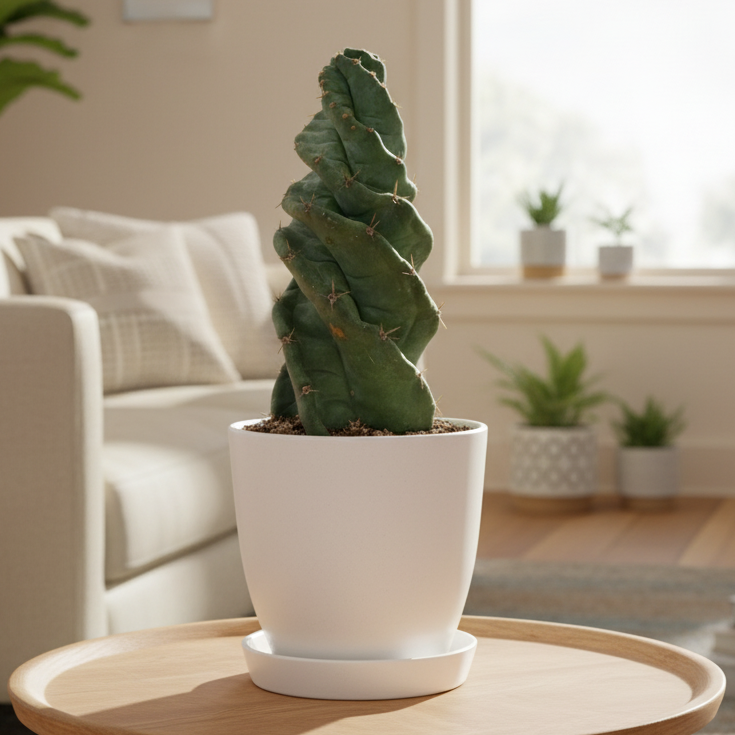


Cereus forbesii 'Spiralis' Cactus
Couldn't load pickup availability
-
![]() Cereus forbesii 'Spiralis', also called Spiral Cereus, is a rare columnar cactus native to South America, particularly Argentina and Bolivia. This cactus belongs to the Cereus genus and grows naturally in dry, rocky terrain where it receives intense sunlight and well-draining soil. It is in high demand among cactus collectors.
 Its dramatic twisted stem corkscrews upward in a tight, symmetrical spiral as it grows. Blue-green ribbed columns are lined with clusters of sharp spines and can reach impressive heights over time. The upright, columnar form of 'Spiralis' makes it a sculptural statement plant that occupies vertical space without spreading.
 It is a night-blooming cactus that produces large white fragrant flowers opening after dark, typically in summer on mature plants. Blooms are fleeting and appear when nighttime temperatures drop consistently. A drop in temperature between day and night triggers flowering in this species.
 Move it outside in summer into full sun to encourage blooming and growth. Rotate it occasionally for even, balanced spiral development. Choose a heavy pot for stability as deep roots develop over time. 'Spiralis' is drought-tolerant and serves as a dramatic indoor focal point or outdoor specimen in warm climates, and can be brought back indoors before autumn temperatures drop.
-
 Cereus forbesii 'Spiralis' Cactus grows well in direct sun to partial sun, requiring at least 4-6 hours of bright light daily.
 Water it deeply every 2-3 weeks in summer, reducing to once a month or less in winter when growth slows.
 'Spiralis' grows well in coarse, fast-draining cactus mix blended with perlite or pumice for extra drainage.
 It prefers temperatures between 65-95°F and should be brought indoors before temperatures drop near freezing.
![]() 'Spiralis' is a slow to moderate grower; feed once in spring and once in summer with diluted balanced cactus fertilizer.
 It is hardy in USDA zones 9-11 and tolerates brief dips to around 25°F but prefers frost-free conditions year-round. It grows outdoors in California, Arizona, Texas, Florida, Hawaii, Nevada, New Mexico, Louisiana, Georgia, South Carolina, Alabama, and Mississippi. Coastal areas of Oregon and parts of the Pacific Northwest can also work in the mildest microclimates within zone 9.
Perfect For Every Occasion: housewarming, birthday gift, thank-you gift, hostess gift, just because, new baby, congratulations, holiday or stocking filler
What This Plant Symbolizes: resilience, endurance, growth, unique beauty, adaptability
A Thoughtful Gift For: a plant-loving friend, a coworker or boss, teachers and mentors, green-thumbed grandparents, your partner, someone starting a new chapter
-
Q: How often should I water Cereus forbesii 'Spiralis' Cactus?
A: Water every 2-3 weeks during summer and once a month or less in winter. The soil should dry completely between waterings.
Q: Is this cactus pet friendly?
A: Cereus forbesii 'Spiralis' Cactus is non-toxic and safe around cats and dogs, but the sharp spines and sap can irritate skin and paws on contact, so keep it out of reach.
Q: Can 'Spiralis' go outside in summer?
A: Yes, it grows well outdoors in full sun during summer and responds with more prolific blooms. Bring it back inside before temperatures drop in autumn and protect it from prolonged heavy rain.
Q: What causes yellowing on the stems?
A: 'Spiralis' turns yellow most often from overwatering or poor drainage. Ensure the pot has drainage holes and allow soil to dry completely between waterings.
Q: How do I propagate Spiral Cereus?
A: Cut a healthy offset or stem section, let it callous for several days, then plant it in dry cactus mix. Roots typically develop within a few weeks in warm, bright conditions.
Q: How large does this cactus eventually get?
A: Spiral Cereus is a slow to moderate grower that can eventually reach 6-13 feet in ideal outdoor conditions, but grows much more slowly indoors, staying manageable as a long-term statement houseplant.