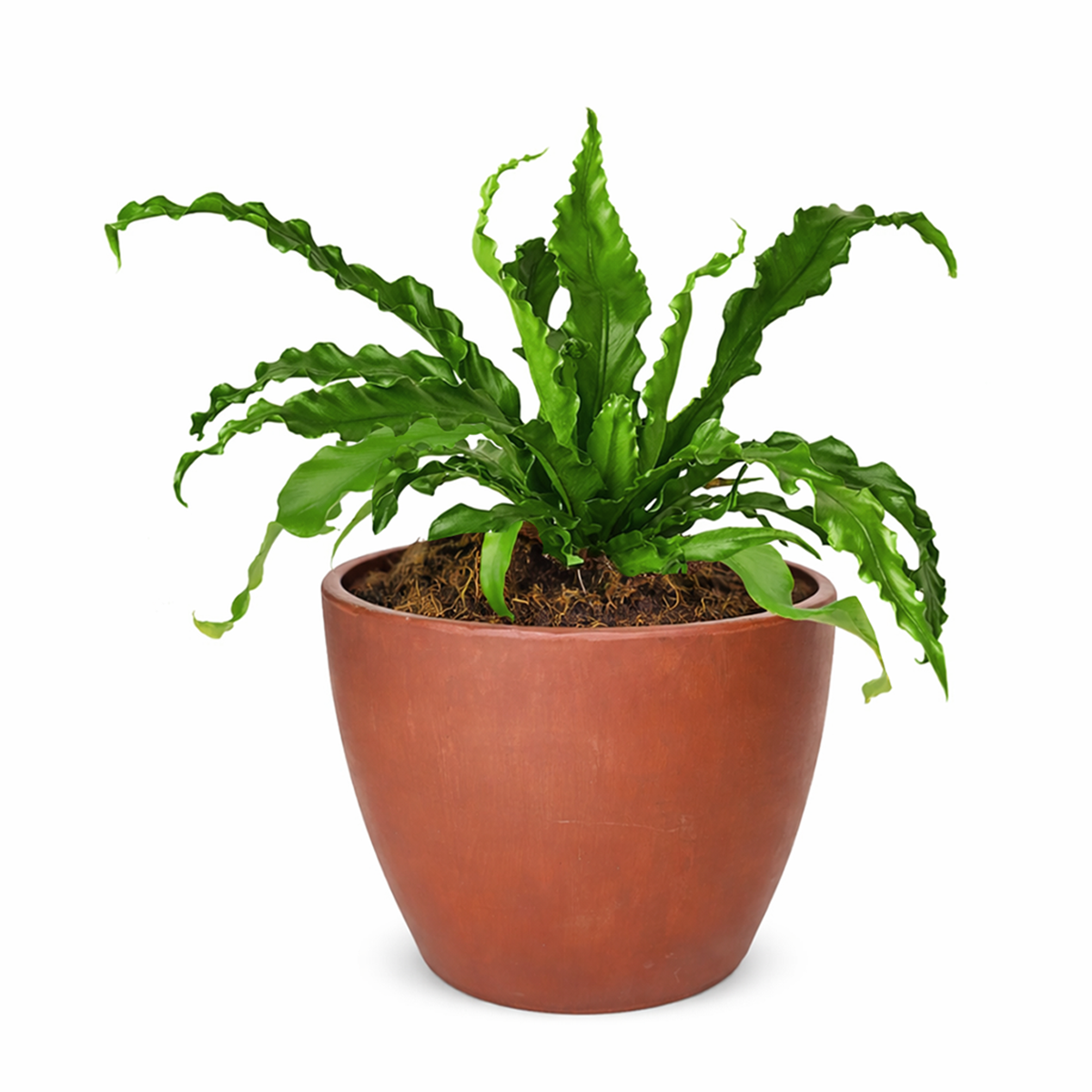


Bird’s Nest 'Victoria' Fern
Couldn't load pickup availability
-
![]() Bird's Nest 'Victoria' Fern (Asplenium antiquum 'Victoria'), also called the wavy bird's nest fern, is a tropical fern native to eastern Asia, including Japan, Taiwan, and Korea, where it grows as an epiphyte on tree trunks and rocky surfaces in humid forest environments. It belongs to the Aspleniaceae family and is closely related to Asplenium nidus.
 The fronds are long, strap-shaped, and glossy green with distinctly wavy or ruffled edges, which set this cultivar apart from the flat-leafed standard bird's nest fern. New fronds emerge from a tight central rosette, pale and tightly coiled, unfurling outward as they mature. The fronds can reach 24 inches or more indoors, and the central cup-shaped rosette collects water and debris just as it would in the wild.
 Ferns do not produce flowers, so Victoria Bird's puts all its energy into foliage growth. It filters indoor air, including formaldehyde and other toxins, and is fully pet-friendly, with no toxicity to cats or dogs. The plant also has a history of edible and medicinal use in parts of Asia, where young fronds are eaten as a vegetable.
 Rotate Victoria Bird's a quarter turn every few weeks so all fronds receive even light exposure. It thrives near kitchen moisture and works well inside a terrarium where humidity stays consistently high. Keep it away from air conditioning and heating vents, as dry or moving air causes the frond edges to brown. You can move it outside in a shaded spot for summer, and if autumn stays mild and frost-free, it can remain outdoors a little longer before coming back in.
-
 Bird's Nest 'Victoria' Fern grows well under bright indirect light and tolerates standard office LED lighting without issue. Avoid south-facing windows, as direct sun scorches the fronds.
 It needs watering when the soil surface begins to dry, roughly every 7 to 10 days. Water at the soil level, not into the central rosette, to prevent rot.
 Victoria Bird's does best in a loose, well-draining mix of peat or coco coir with perlite and a little orchid bark. Good aeration around the roots prevents waterlogging.
 It prefers temperatures between 60°F and 85°F and struggles below 50°F. Keep it away from cold drafts near windows in winter.
![]() Victoria Bird's is a slow to moderate grower, putting out a few new fronds per month during the warm season. Feed it with a balanced liquid fertilizer diluted to half strength once a month in spring and summer.
 It is hardy in USDA zones 10 to 12, where frost is rare and temperatures stay above 30°F. It grows outdoors year-round in Hawaii, southern Florida, and parts of coastal Southern California. It also grows outdoors in warm, frost-free pockets of Arizona, Texas, and Louisiana during the warmer months.
Perfect For Every Occasion: housewarming, office party, desk plant, thank-you gift, birthday party favor, get-well gift, teacher appreciation
What This Plant Symbolizes: growth and adaptability to change, resilience and endurance, air purifying, renewal and protection
A Thoughtful Gift For: pet-loving friends and families with cats or dogs, beginner plant enthusiasts, a coworker or boss with a low-light office, anyone who loves growing plants in humid bathrooms, someone seeking air-purifying houseplants
-
Q: Is Bird's Nest 'Victoria' Fern safe for cats and dogs?
A: Yes, it is fully non-toxic and pet-friendly for both cats and dogs.
Q: How do I know when it needs water?
A: Bird's Nest 'Victoria' Fern wilts slightly and the fronds lose a little firmness when it has gone too long without water. Check the top inch of soil and water when it starts to feel dry.
Q: What kind of light does Victoria Bird's need?
A: A north or east-facing window works well. West-facing windows are fine with a sheer curtain. A south window without filtering will scorch the frond edges.
Q: How big does it get indoors?
A: Victoria Bird's typically reaches 18 to 24 inches tall and wide in a standard indoor pot, with individual fronds growing up to 24 inches long under good conditions.
Q: Can Victoria Bird's handle low humidity in a heated home?
A: It browns at the frond edges in dry air. Placing it near a kitchen, running a nearby humidifier, or growing it inside a terrarium keeps humidity high enough.
Q: How sensitive is it to being moved around the house?
A: Victoria Bird's takes time to adjust after a location change, sometimes dropping or stalling new frond growth for a few weeks. Settle on a stable spot and avoid frequent repositioning.