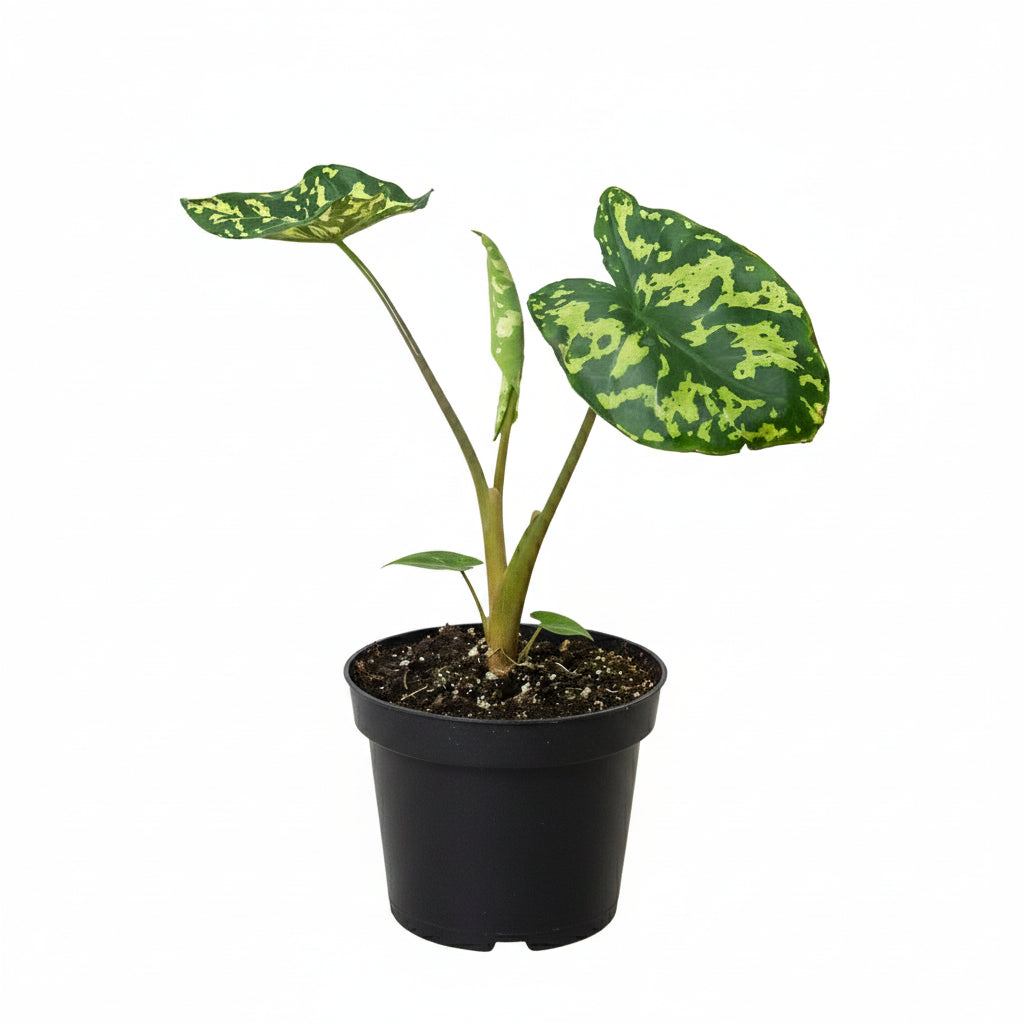


Alocasia 'Hilo Beauty'
Couldn't load pickup availability
-
![]() Alocasia 'Hilo Beauty', also called Camouflage Alocasia, is a rare tropical houseplant in the Araceae family, native to the tropical rainforests of Southeast Asia. It belongs to the elephant ear plant group, grown for its dramatically patterned foliage that sets it apart from most common houseplants.
 The leaves of 'Hilo Beauty' are broad and arrow-shaped, with a deep green base splashed in irregular patches of cream, pale green, and yellow-green that resemble a camouflage pattern. Each leaf can reach up to 18 inches long on mature plants, held upright on long, pale stems. The variegated foliage on every leaf is unique, so no two leaves carry exactly the same pattern.
 As a rare tropical collector plant, 'Hilo Beauty' is grown primarily for its foliage rather than its blooms. It can produce small spathe-type flowers typical of the Araceae family, but these appear infrequently indoors and are not the main reason growers seek it out. It purifies indoor air, pulling airborne contaminants from the surrounding environment.
 Rotate 'Hilo Beauty' every week or two so all sides receive even light exposure. It thrives near a kitchen where ambient moisture from cooking keeps the humidity higher than in other rooms. Sensitive to being moved, it may drop a leaf or two after a change of location, which is normal. This is a rare find in the houseplant world, and collectors actively seek it out for its one-of-a-kind variegated foliage.
-
 Alocasia 'Hilo Beauty' thrives in bright indirect light, away from direct sun that scorches leaves.
 Water it every 7-10 days, letting the top inch of soil dry between waterings.
 'Hilo Beauty' does best in a well-draining mix of peat, perlite, and orchid bark.
 It prefers temperatures between 65°F and 85°F and should stay away from AC or heater vents.
![]() 'Hilo Beauty' is a moderate grower; feed it with a balanced liquid fertilizer monthly during spring and summer.
 It is hardy in USDA zones 10-11, where frost is rare and temperatures stay above 30°F. It grows outdoors year-round in Florida, Hawaii, southern California, and coastal Texas. In cooler states, move it outside for summer, then bring it back indoors before temperatures drop below 60°F.
Perfect For Every Occasion: housewarming, plant collector gifts, birthday party favor, thank-you gift, indoor garden upgrade, holiday or stocking filler, office party
What This Plant Symbolizes: vibrant uniqueness, tropical elegance, resilience, natural beauty, growth
A Thoughtful Gift For: a plant-loving friend, indoor jungle enthusiasts, interior design lovers, mom or mother-in-law, a coworker or boss, urban gardeners
-
Q: How much humidity does Alocasia 'Hilo Beauty' need?
A: It needs high humidity, ideally above 60%. A humidifier nearby or placement in a naturally humid room like a kitchen works well.
Q: What does it look like when this plant needs water?
A: Alocasia 'Hilo Beauty' wilts slightly when the soil has dried out too long. Check the top inch of soil and watch for softening leaf stems as early signs.
Q: Is 'Hilo Beauty' safe to keep around pets and children?
A: Cats and dogs shouldn't be left to nibble or eat the plant, and the sap can irritate skin and paws on contact. Keep it on a high shelf out of reach, and place it away from small children.
Q: Can this plant go outside in summer?
A: 'Hilo Beauty' can move outside for summer in a sheltered spot with bright indirect light. Cover it from heavy rain, and bring it back in before nighttime temperatures drop below 60°F.
Q: Why is Camouflage Alocasia so hard to find?
A: It is a genuinely rare cultivar, produced in smaller quantities than common Alocasia varieties. Stock tends to sell out quickly when it does appear.
Q: How fast does this plant grow?
A: Camouflage Alocasia grows at a moderate pace, pushing out new leaves roughly every few weeks during the warmer months. Growth slows noticeably in winter as the plant rests.